The situation
Capsule was a seed-stage video technology company preparing to launch AI Studio, its AI-powered video editor. The product vision was strong and the waitlist was growing, but the website and positioning still reflected an earlier version of the company. I came in as a fractional product marketing and content lead across positioning, website strategy, competitive intelligence, content and SEO, launch planning, and demand-gen infrastructure.
The decision
Two decisions defined the engagement. The first was positioning. My read was that competitors had already taken “easy AI video editing,” so I analyzed six of them company by company and put the alternatives back through Capsule’s customer advisory board. That loop resolved the real tension — professional output and accessibility for people who find editing software intimidating — and produced the claim the site went out with: professional-quality video made accessible, with brand control intact. The benefit was the outcome a marketing team wants; the AI was how it got delivered.
The second is the one I’m proudest of. AI Studio had more than 10,000 people on the waitlist, and raw signups aren’t equally valuable. The team needed to find the enterprise buyers inside that crowd without adding friction that killed conversion. I designed a segmented journey around one deceptively simple opening question — how the person would use the product — which quietly qualified work users by function and company size while keeping the experience light for individual creators. The flow was specified so that qualified prospects entered a referral loop and best-fit accounts routed into casual CEO-led outreach, designed to turn a waitlist signup into a demo and accelerated access. This was marketing infrastructure rather than form UX, documented for build down to the routing and deal-creation rules. The goal shifted from optimizing waitlist size to optimizing commercially relevant demand.
One question, three routes
The opening question
“How will you use Capsule?”
Qualifies by function and company size, without adding friction.
Individual creators
Kept light
No extra friction for people signing up for themselves.
Qualified work users
Referral loop
Qualified prospects entered a referral loop.
Best-fit accounts
CEO-led outreach
Routed to casual CEO outreach, toward a demo and accelerated access.
I also reframed the SEO problem honestly. Capsule was competing against domains with millions of monthly visits, so attacking the highest-volume terms head-on wasn’t a credible near-term path. I recommended narrower product-led pages Capsule had a right to own, and treated rankings as a distribution and authority problem instead — a borrowed-audience strategy of directories, podcasts, partner content and original research, using the waitlist itself as the research audience.
The three decisions are one decision
Choosing the buyer told everything else what to do.
Told the homepage
What to say
Told the SEO plan
Which terms were worth contesting
Told the signup flow
What to ask
Told the CEO
Who to email
That is the work: not a clever waitlist, a commercial system built around a launch.
The goal wasn’t a bigger waitlist. It was finding the future customers already inside it.
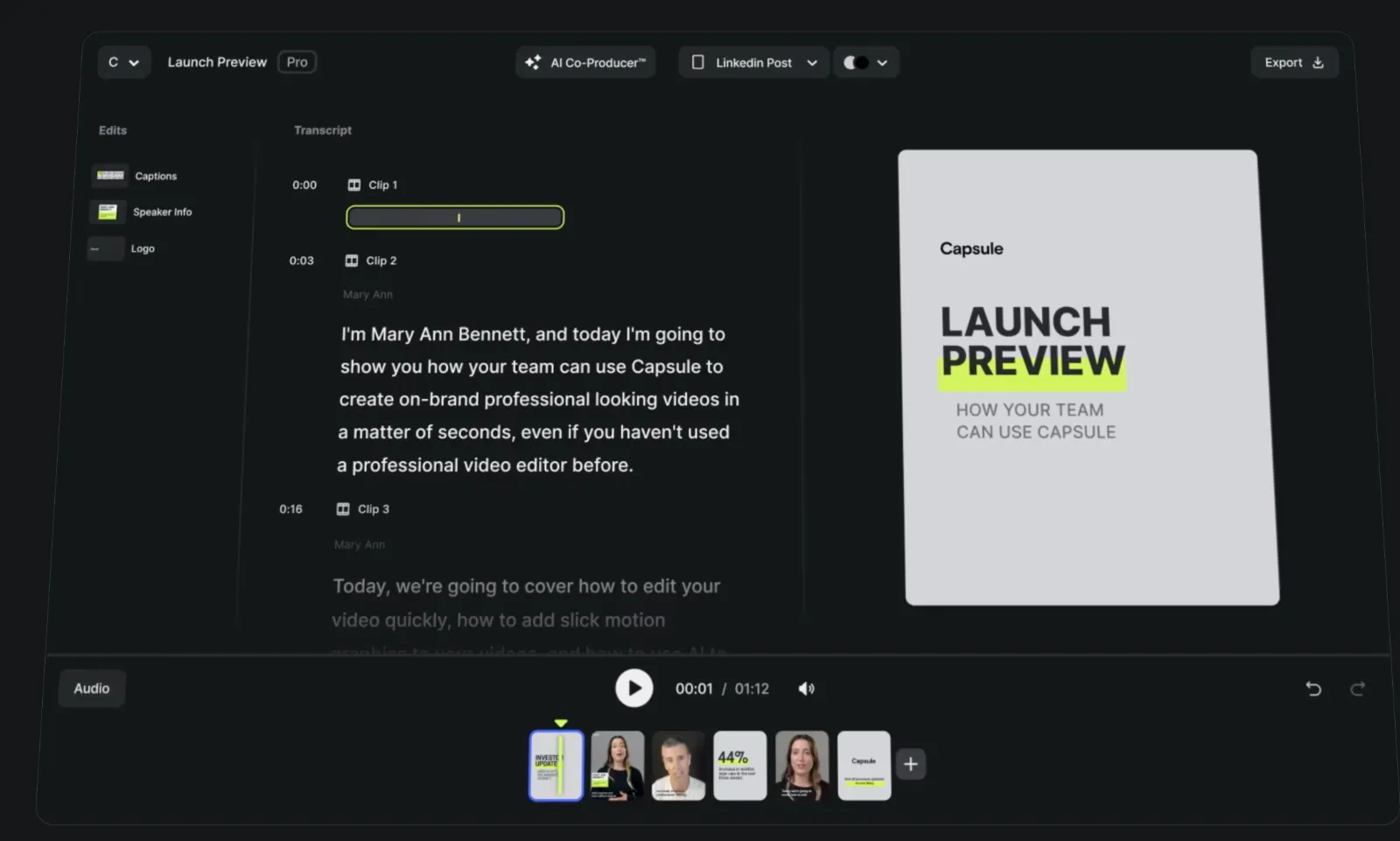
02 · The product · launch preview
The transcript
is the timeline
The claim, made literal
Capsule editor · launch preview
Direct product capture · not archived
Edit the transcript, edit the video
Pre-launch engagement
Full scope
The decision above carries the argument. Everything below ran inside the same engagement, catalogued.
- 6
- workstreams
- 1
- channel
01Positioning & launch
6 workstreams · none public
Homepage architectureWebsite · shipped
Repositioned around a primary buyer, written and shipped.
Competitive analysisResearch
Feature-level, across six direct competitors.
Product-led SEO strategyStrategy doc
Content mapped across the funnel to pages Capsule could credibly own.
Waitlist qualification engineDemand-gen system
Segmentation logic, referral mechanics and the CEO outreach sequence, documented for build.
Content & distribution strategyStrategy doc
Authority built off-site rather than contested on search: research, partners, directories.
Site redesignWebsite
The work expanded into the broader site ahead of launch.
The bottom line
The homepage redesign went live and the engagement expanded into the broader site, a fair signal of internal confidence in the work. The competitive analysis turned a vague “we need more content” into a concrete acquisition problem, and the waitlist work designed the architecture to turn a generic signup list into a segmented acquisition, referral and qualification system. Most of the work was pre-launch, so downstream conversion and demand numbers aren’t mine to report, and I’ve kept internal targets out since they were projections.