
The situation
Coursera is a public company with a mature in-house marketing function, and I came in as an outside editorial lead on the B2B side. What I saw was a company producing enormous amounts of proprietary research, most of it published once and then left to sit. The work I was brought in for was the flagship, high-stakes end of that: the annual report, and the machinery that decides whether it keeps earning after launch week.
The decision
The 2024 edition, Coursera’s fourth annual, introduced a methodology combining on-platform data with third-party indices, and the internal draft of the technical appendix was unreadable. The problem was structural, and I treated it that way. Rather than rewrite the appendix down, I set the relationship between two things that already existed: the appendix stayed the thorough version, and the front-of-book “how to read this report” section became the accessible one. My aim was for the same methodology to hold up for a data-skeptical CIO and a curious learner without dumbing down for either. When the first rewrite over-corrected toward simplification, I pushed it back. I did the same work again the following year.
The technical appendix
Stayed the thorough version
Holds up for a data-skeptical CIO.
“How to read this report”
Became the accessible one
Same methodology, for a curious learner. No dumbing down for either.
The harder editorial problem was scale. The report covers 109 countries across six regions, all of it moving through multi-stakeholder review. I built a container for it: a fixed spotlight architecture per region at set lengths, regional forewords, and a four-tier country taxonomy — cutting-edge, competitive, emerging, lagging — that other people then designed pages against. That is the part I would point to. Writing at volume is a staffing question; keeping volume coherent under review is a structural one.
The container
One structure, 109 countries
countries
109
regions, each with a foreword and fixed spotlights
6
tiers every country is placed in
4
Tier 1
Cutting-edge
Tier 2
Competitive
Tier 3
Emerging
Tier 4
Lagging
Most of what made me re-hireable was less visible than either. I sourced every quote with a timestamp so a reviewer could check it, listed what I would fix before drafting rather than waiting for the review round to surface it, and insisted on proportional representation across contributing universities instead of over-indexing on the standouts. When a client’s reviewers are internal stakeholders and the subjects are university administrators, that discipline is the product.
The higher-leverage decision was to treat the report as the start of a distribution system rather than the end of one. I audited and extended the internal enablement toolkit, expanded the existing FAQ so any employee could defend the methodology in a customer conversation, and shipped outbound templates. Ten repurposing angles came out of it, three of which were developed into vertical blogs. On a separate webinar-synthesis project, the public article carried the narrative and linked out to the CampusTalks landing experience, while the deepest implementation detail went into the companion playbook.
CampusTalks itself started as a budget range with no format attached. I argued against a static playbook and proposed an interactive build before the scope came back — which is what the engagement looked like at its best: asked what was possible, not handed an order.
Writing at volume is a staffing question. Keeping volume coherent under review is a structural one.
02 · Published artifact · live
A thesis, not
a recap
14 universities → 5 patterns
Updated May 13 2026 · Coursera Enterprise
14 universities · four continents
Editorial by Comarketer.ai · published under Coursera’s byline
The editorial call — “imperfectly, and succeeded anyway”
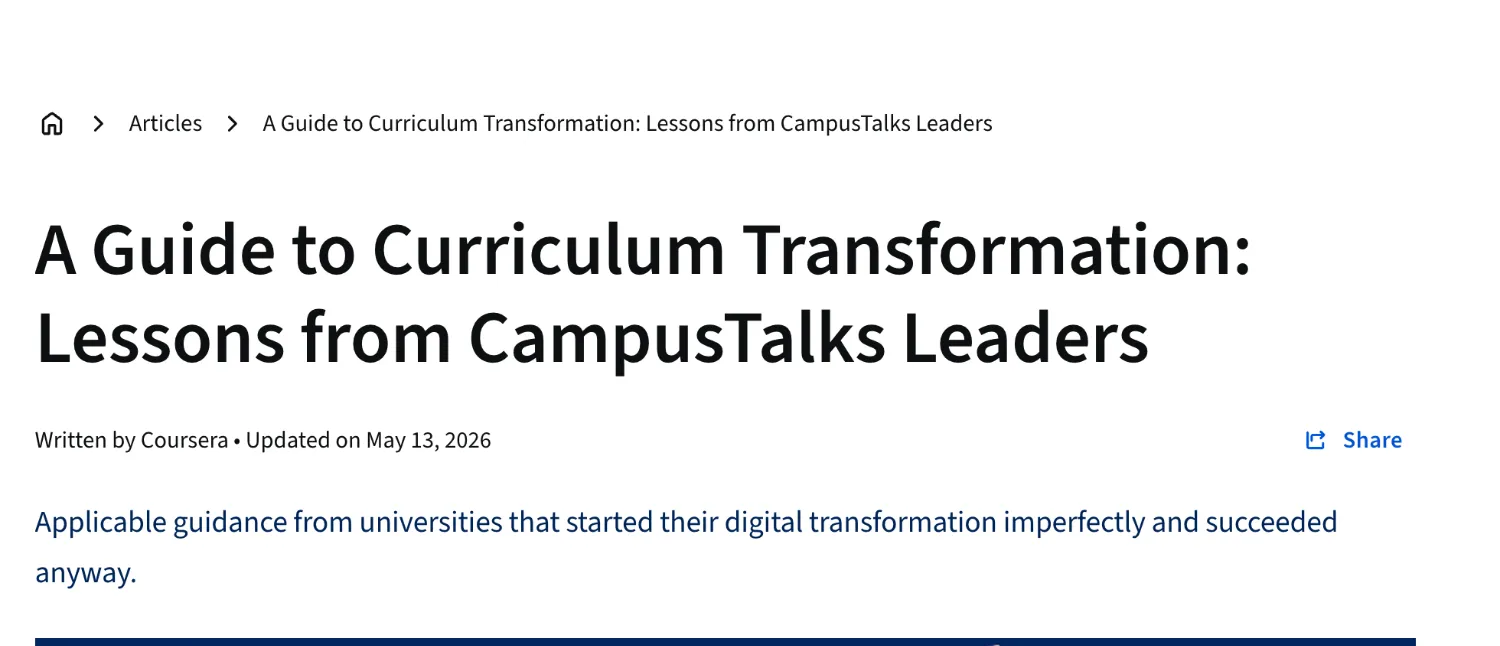
03 · The synthesis · published
A Guide to Curriculum Transformation: Lessons from CampusTalks Leaders
14 universities → 5 patterns














- 1Faculty preparation determines outcomes
- 2Integration depth beats breadth
- 3Communication at unexpected intensity
- 4Measurement enables momentum
- 5Partnership depth determines value
Multi-year engagement
Full scope
The decision above carries the argument. Everything below ran across the same multi-year engagement, catalogued.
- 8
- workstreams
- 4
- public, linked
- 2
- tracks
01Flagship research
4 workstreams · 2 live
Global Skills ReportAnnual research reportLive
Lead copywriter and editor across consecutive years.
View it live →Micro-Credentials ReportResearch reportLive
Methodology and survey framing.
View it live →GSR Employee ToolkitSales enablement
Existing enablement audited, extended and systematized for the sales org.
GSR promotional videoVideo script
A twelve-scene script with scene-level voiceover.
02Editorial & repurposing
4 workstreams · 2 live
Report repurposing programContent program
Ten article concepts generated; three developed into vertical blogs.
UT System case studyCase studyLive
One study in a series, built from interview transcripts.
View it live →AI on CampusEditorial brief
Brief and editorial approach for a higher-ed leadership audience.
CampusTalks WrappedArticle + playbookLive
Scoped the SOW, then produced the master article, playbook and creative.
View it live →The bottom line
This was a multi-year recurring engagement, and I was trusted with the flagship report across consecutive years. It also survived a workstream being stopped mid-flight when it didn’t clear the quality bar — the call came from the client, I agreed with it, and I invoiced only for completed work. That’s the strongest evidence I can offer of the relationship’s quality. The report’s own statistics are Coursera’s, so I don’t present them as my results.