The situation
unitQ sells an AI Quality Intelligence platform to product, CX, and support teams at companies like Pinterest, PayPal, Bumble, and DraftKings. When I came in as a contractor on the marketing team in December 2025, the content engine was close to greenfield: roughly 3.7K monthly organic visits, an authority score of 29, and a top-ranking organic term of “is real talk legit,” which tells you how little of the footprint captured buyer intent. AI-search visibility sat at 0% share of voice. The blog couldn’t support inline CTAs or gated-asset links, and there was no marketing-owned web surface at all. I was brought in to build the content and SEO engine, and the scope grew from there into campaigns, web builds, thought leadership, and demand gen.
The distribution insight that saved a quarter of production
An AI-search tool showed unitQ at zero share of voice in AI-generated answers. The default read for a content strategist is to publish more and publish better. My audit of around 40 AI responses showed that was the wrong call. The existing content plan was already about 70% aligned to how AI answers get built. The citations feeding competitors’ visibility were coming from off-site sources, Reddit the single largest, plus third-party listicles, YouTube, and Medium. Some competitors were winning on earned citations, others purely on domain authority.
So I reordered the whole strategy. Third-party listicle inclusion went above owned publishing. Reddit signal detection got automated through Clay while every response stayed human-written. And the target list led with the beatable competitors rather than the aspirational ones. I also killed a proposed custom dashboard pipeline in favor of native integrations plus one consolidating sheet, and sequenced the editorial calendar first, because the automation targets depended on it.
The reason this matters: writing more content would have felt productive and changed nothing, because the problem was never the content. It was a citation supply chain unitQ had no presence in. Naming that saved a quarter of misdirected production.
The gap wasn’t the topics. It was that the whole plan lived on our own site, and AI-search citations are earned almost entirely off it.
Epic Awards: a campaign deadline used to de-risk a platform decision
unitQ had no owned demand-gen program and no marketing-controlled web surface, and the company had been stuck for months on whether to migrate off engineering-dependent publishing. I proposed building the Epic Awards microsite in Webflow as a contained pilot, which shipped the campaign and de-risked the platform decision in one move. The program launched with 40 winners across six categories, selected algorithmically from 83M-plus public app-store reviews across 6,700-plus apps, under the tagline “Your users decided. The data confirmed.”
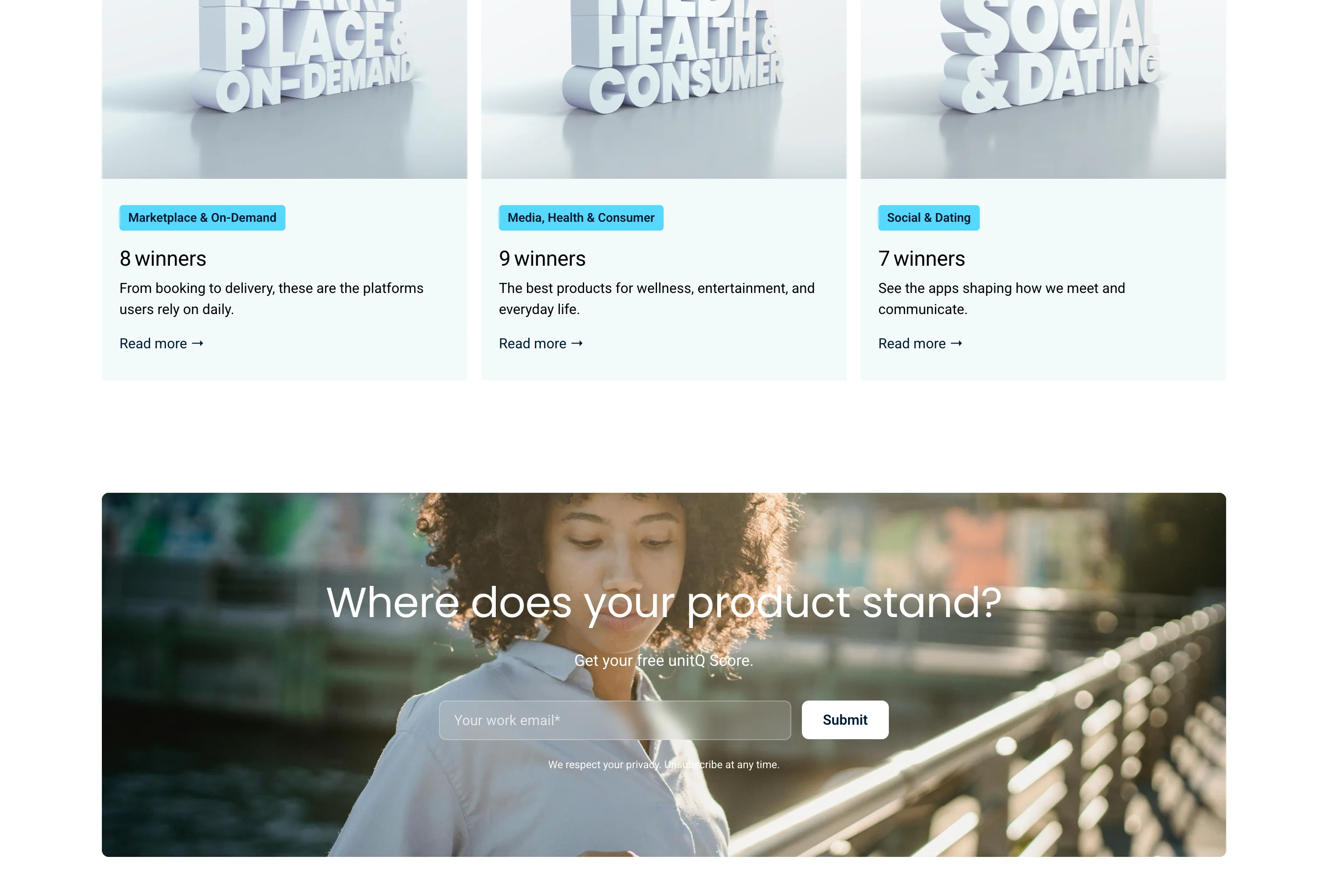
The build decisions were about defensibility. Winners were listed alphabetically so no ranking could be reverse-engineered, individual scores were never published, and results were framed in absolute counts (“40 out of 6,700+ apps”) rather than percentiles. The methodology was user-driven: no nominations, no panel, no fees. I also built a “How to win” page as the conversion surface for non-winners, and that page turned out to be the strongest buying signal in the whole program.
That last part reframed the program. The awards weren’t generating winner goodwill. They were generating warm pipeline, because non-winners were raising their hands.
A campaign deadline is the cheapest way to test a platform decision.
02 · The Epic Awards program · live site
Built, shipped, running
Forty companies recognised without applying or paying
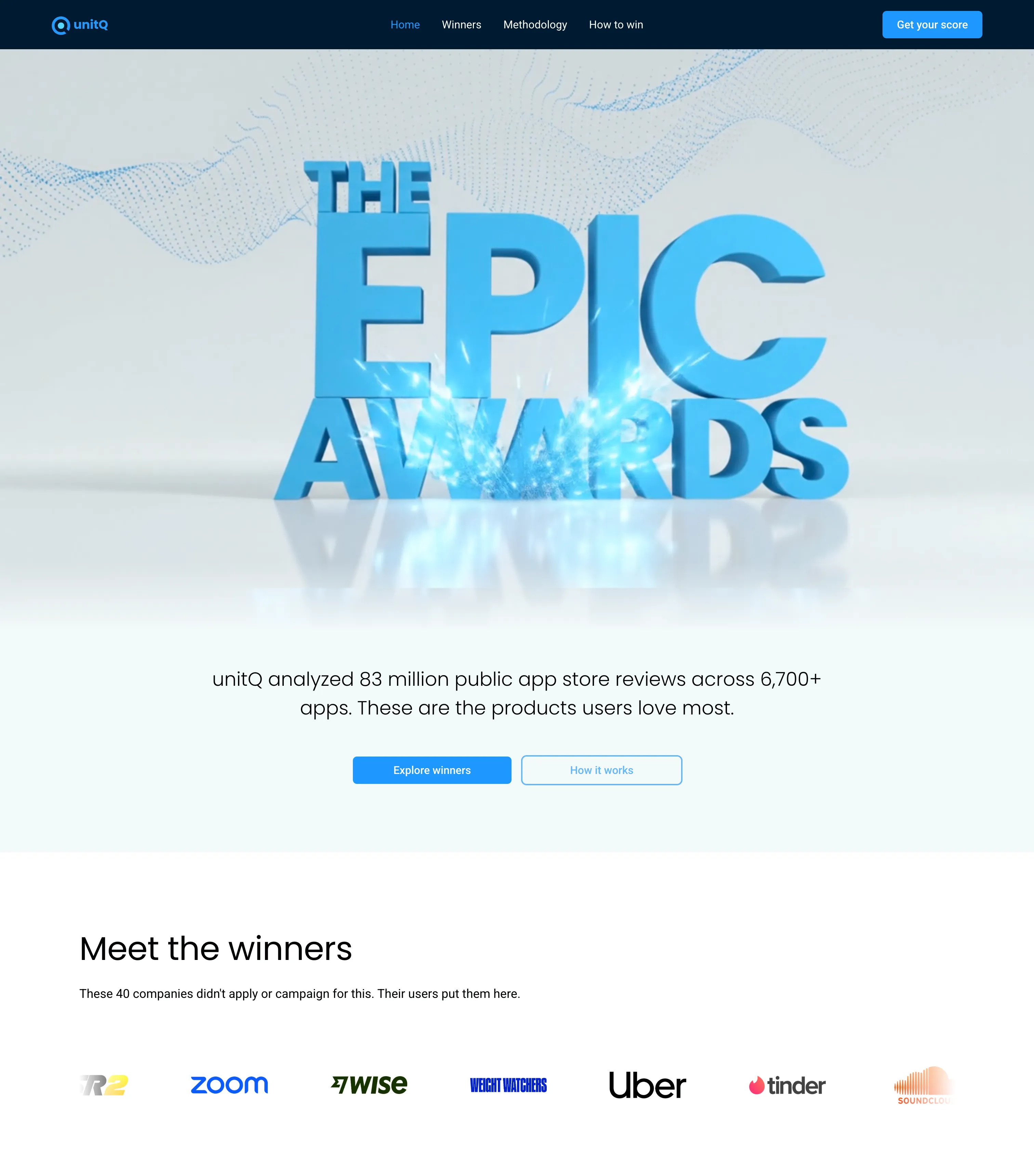
03 · Conversion surface · non-winners
Goodwill → pipeline
The companies that didn’t win asked to be measured
Expected
Winner goodwill
Actual
Warm pipeline from non-winners
Inside the same engagement
Full scope
The two stories above carry the argument. Everything below ran inside the same engagement — one content and demand operation, catalogued.
- 12
- workstreams
- 3
- public, linked
01Content & SEO
4 workstreams · none public
Three-tier content strategy
A 25-piece roadmap built across three tiers of intent.
AIO/GEO strategy
Competitive citation audit, off-site tactics, editorial calendar, measurement.
Blog optimisation program
Inline quote blocks, CTAs, and schema-marked FAQ sections.
Voice & style guide
Documented, so the standard outlasts the engagement.
02Research & launches
4 workstreams · 2 live
2026 Benchmark Report
67.7M reviews across 8,000 apps, run from gated page to social program.
Quality Research HubLive
The launch package for marketing’s research home.
View it live →Epic AwardsLive
An awards program built as a contained Webflow pilot.
View it live →Dan Olsen webinar
A fireside conversation, promoted end to end.
03Web & thought leadership
4 workstreams · 1 live
Webflow migration
Blog redesign, and marketing’s first self-owned web surface.
Forbes bylineLive
Ghostwritten for the CEO, published after a prior rejection and a revision round.
View it live →G2 review sprint
A plan for concentrated review generation.
Pipeline dip narrative
The leadership story around a Google Ads dip.
The bottom line
Two things outlasted the campaigns. I set the sourcing standards the marketing org now works under, retired stats, approved anchors, verification before publish, and I built marketing’s first self-owned web surface, ending full dependence on engineering to publish a page. The measurement infrastructure was being built alongside the work rather than before it, so some flagship numbers (Epic Awards microsite traffic, post-engagement organic) live in systems that came online mid-project. Where a figure isn’t cleanly attributable, I’ve left it out.